A short study of cruciform half hour markers on English clocks
In the realm of antiquarian horology, certain features may seem trivial to the untrained eye, yet they hold significant value in understanding the evolution of timekeeping. One such feature, the half-hour marker, it serves a purely functional purpose, helping the user discern the passage of time with precision. While today we may take for granted the easily identifiable minute markers on our modern clocks, this was not always the case. In the 16th century, when domestic clocks were first being created with only single hands, the need for half-hour markers was essential. The absence of minute hands meant that these markers would be positioned between the hour indications, a simple yet ingenious solution to accurately convey the progression of time.
Over the centuries, as clockmaking techniques evolved, so too did the design of these markers. The earliest examples were stark in their simplicity, often little more than notches or subtle indentations on the dial. Yet, like many aspects of horology, they gradually became more refined and complex, reflecting the growing sophistication for design. In this study, I will endeavour to categorise and examine these half-hour markers, tracing their development and identifying distinct types that can be dated and placed within specific periods. Though each marker might appear unique at first glance, they all share a common purpose and a striking similarity in form. Join me as we embark on a brief yet fascinating exploration of these often-overlooked yet historically significant elements of antique clocks.
Cruciform half hour markers
As we delve deeper into the development of half-hour markers, it becomes evident that there are numerous ways to categorise these intricate designs. One of the earliest and most recognisable forms is what I have come to describe as the “cruciform type.” This first type 1, as with many early innovations, is characterised by its simplicity, and dates back to the first phase of lantern clocks, specifically around the early 17th century—circa 1620. This period was one of significant change in England, marked by the rise of Puritanism and a deeply religious atmosphere, so it should perhaps come as little surprise that some of the earliest half-hour markers took the form of a cross. Whether this was a deliberate religious statement or merely a coincidence is difficult to say, but its presence on these early timepieces is noteworthy. What is clear, however, is that these early cruciform type clocks are rare, suggesting they were short-lived and did not remain in widespread use for long.

Moving on, we come to what I have termed the “cruciform type 2,” which, while still bearing the fundamental cross shape, shows a significant departure in design. The engraver adds extra lines, transforming the cross into something more akin to a wheatsheaf. This refinement, though subtle, marks a clear progression in the design language of half-hour markers, and this form would continue to be popular for much of the 17th century and into the 18th. At this stage, however, the design remains restrained, with the cross-like symbol retaining a certain look that reflects the period’s still-strong religious undertones.
As we transition into types 3 and 4, we begin to notice a notable shift in size. The markers become larger and more prominent, a trend that would dominate throughout the mid-17th century. This growing emphasis on scale is indicative of a broader trend in horology, where the focus was not just on the accuracy of timekeeping but also on the visual impact of the clock’s design. However, it is not until the last quarter of the 17th century, during type 5, that the cruciform truly begins to evolve. At this stage, the cross expands, adding two little tails at either end, transforming it into something more ornate and expressive occasionally on type five you also see tales on the stem. Now the cross was more than just a functional marker; it became an artistic statement.
Finally, in type 6, we see the pinnacle of the cruciform design. The half-hour marker reaches its most refined form: larger, symmetrical, and still elegant in its simplicity. This phase marks the zenith of the cruciform type, where it has shed its more austere beginnings to become a bold and prominent feature of clock design. This particular design being the favourite of many prominent clockmakers of the late 17th and early 18th centuries such as Thomas Tompion.
Floating and Later Cruciform Variants

Following the pinnacle of the cruciform half-hour marker in phase 6, we see a further evolution, albeit one that is more subtle and less frequently encountered: the floating half-hour marker, or “type 7.” This variation is essentially a continuation of the type 6, but with one notable distinction—it lacks the stem that had previously extended from the cross, making it appear “floating” in the space between the hour markers. While this design choice maintains the fundamental shape of the cross, the absence of the stem makes it more difficult to visually distinguish the half-hour mark from the surrounding hour indicators. As a result, this type is less common, perhaps because it was more challenging to interpret at a glance, although its design retains the characteristic of its predecessor.
The final stage in the evolution of the cruciform half-hour marker comes with the introduction of type 8, which marks a significant departure from the earlier forms. This version, which became prominent in the early 18th century, shows the more restrained tastes of the period. The design is more refined and understated, catering to the evolving sensibilities of the time. The cross takes on a more plain, elongated shape, often referred to as the “ lozenge-shaped” cross, and is less ornate than its predecessors.
Fancy cruciform half hour markers
As the 17th century progressed and gave way to the 18th century, the cruciform half-hour markers began to adopt a more elaborate and decorative style. This shift marked the emergence of what I refer to as the “fancy cruciforms,” a distinct progression from the simpler, functional designs of earlier phases.
The journey of this decorative evolution begins with Type 1 of the fancy cruciforms. Here, we see the first steps towards embellishment—a few simple lines introduced between the upper sections of the cross. This subtle addition begins to hint at the more ornate forms to come, while still retaining the restrained elegance of earlier designs. It is in Type 2, however, that we witness the transition into a more symmetrical and balanced form. This type, one of the most commonly encountered variations, features two elegant “C” shapes that frame the cruciform, adding flow and movement to the previously static design. The symmetry and fluidity of this type would become hallmarks of the fancy cruciform style.
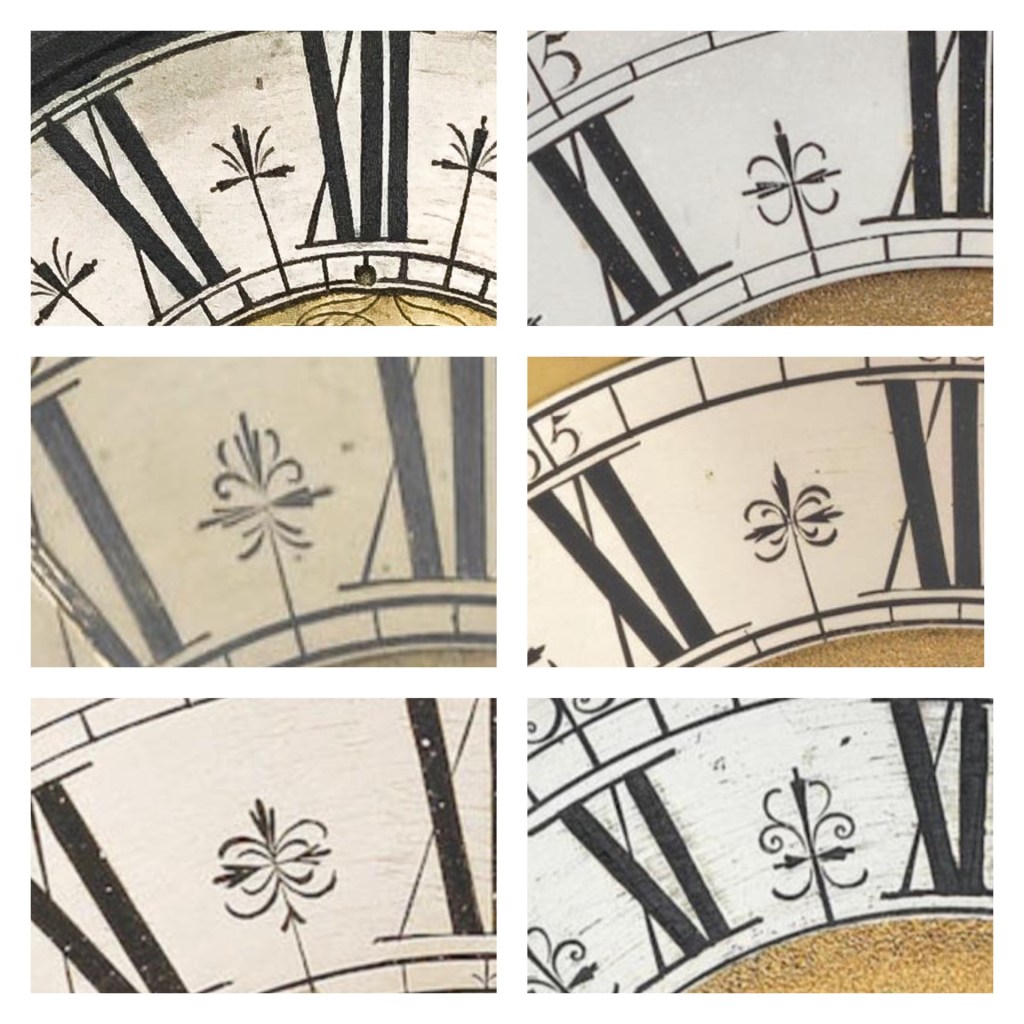
As we move through Types 3, 4, 5, and 6, the markers follow a general trajectory of increasing complexity and decoration. Each subsequent type introduces more elaborate engravings and finer details, with the cross becoming a canvas for the engraver’s skill and creativity. While these markers generally adhere to a progression of growing intricacy, exceptions to the pattern do exist. Some markers retain a simpler look, likely due to personal preference or regional variation among clockmakers.
Despite occasional deviations, the majority of cruciform half-hour markers from this period can be categorised within these distinct types, each representing a chapter in their evolution. Through these types, we can chart the journey of the cruciform half-hour marker, seeing how it transformed over years from a simple functional tool into a more decorative symbol. What began as a deeply religious form gradually evolved to align with the refined, restrained stylistic preferences of the Enlightenment period.
This progression—from the ornate and heavily adorned designs of the 17th century to the more minimalist and symmetrical forms of the 18th century—not only reflects the advancements in horological fashions but also offers a fascinating lens through which to view the broader cultural shifts of the times. These markers, though small and often overlooked, are tangible reminders of the tastes of the 17th and 18th centuries, serving as both functional elements and decorative artefacts of history.
All images rights reserved Bonhams©️

 Lewis Walduck
Leave a comment